
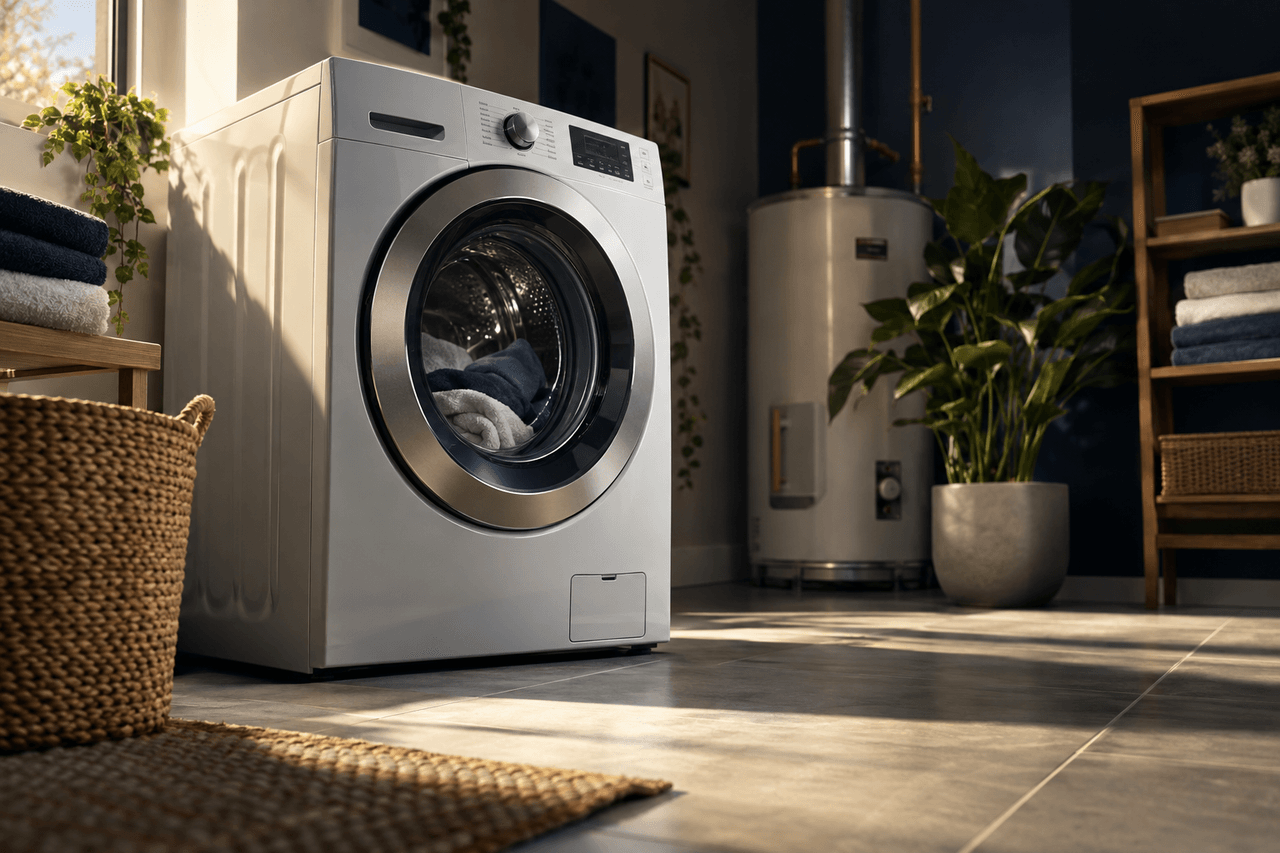

A clothes washer uses anywhere from 400 to 1,400 watts while running, but the single biggest factor in its electricity cost is not the motor, it is the water heater behind it. Understanding where those watts go gives Texas households a clear path to lower laundry bills, especially when electricity rates vary as widely as they do in the deregulated market.
The Wattage Range, Explained
The U.S. Department of Energy's typical-wattage table lists a clothes washer at 350 to 500 watts, though nameplate ratings on standard top-load models often read higher (up to roughly 1,400 watts) because the plate reflects peak draw. High-efficiency (HE) front-load models typically draw 300 to 500 watts for the motor and drum rotation. Those figures cover the mechanical work of agitating and spinning clothes.
What the nameplate wattage often leaves out is the energy consumed heating water. When a machine calls for a hot or warm wash, the electric water heater supplying it may draw 4,000 watts or more on its own. That energy never shows up on the washer's label, but it lands squarely on the electricity bill.
The arithmetic is easy enough to run directly. A standard top-load machine uses about 20 gallons of water per load, compared with 14 gallons for an ENERGY STAR certified full-size washer, per ENERGY STAR. Heating roughly that much water through a 60-degree temperature rise takes on the order of 3 kilowatt-hours in an electric water heater, so switching a single load per week from hot to cold saves somewhere in the neighborhood of 100 to 150 kilowatt-hours per year on a full hot fill, and less in a high-efficiency machine that fills with 14 gallons or fewer, or on a warm rather than hot setting.
Top-Load vs. Front-Load: What the Numbers Show
The type of machine matters, both for wattage and for water volume, which links back to water-heating costs.
Standard top-load agitator machines are the most common in older Texas homes. They use more water per load (about 20 gallons for a standard machine versus 14 for an ENERGY STAR certified one, per ENERGY STAR) and typically draw 700 to 1,400 watts during the wash cycle. Their motors work harder because the agitator must move against a full tub of water.
High-efficiency top-load machines (no center agitator, impeller wash action) reduce water use to roughly 13 to 20 gallons per load and draw closer to 400 to 700 watts.
Front-load HE machines are the most efficient category. Water use drops to 10 to 14 gallons per load, motor draw falls to 300 to 500 watts, and spin speeds are higher, meaning clothes enter the dryer drier and the dryer runs shorter. ENERGY STAR-certified front-loaders use about 50 percent less energy and water than a top-load agitator machine, per ENERGY STAR.
How to Calculate Your Washer's Electricity Cost
The formula is straightforward.
- Find the wattage on the machine's label (or in the owner's manual).
- Estimate how many hours per week the machine actually runs. A typical load takes 45 to 75 minutes; a family of four might run 7 to 10 loads per week.
- Multiply: Watts x Hours per week / 1,000 = kilowatt-hours (kWh) per week.
- Multiply kWh by your rate in cents per kWh, then divide by 100, to get weekly cost in dollars.
Example: A 900-watt top-load machine running 8 hours per week uses 7.2 kWh per week, or about 374 kWh per year. At the median listed rate of 14.7 cents/kWh across plans listed on ChooseMyPower.org as of November 23, 2026, that comes to roughly $55 per year for the washer motor alone, before adding water-heating costs.
At the cheapest listed plan (6.3 cents/kWh all-in at 1,000 kWh, Chariot Energy Bill Break 12, in the lowest-cost utility area, per ChooseMyPower.org as of November 23, 2026), that same load of annual wash-cycle energy would cost closer to $24. The difference, about $31 per year on one appliance, illustrates why plan selection matters even for moderate energy users.
The Bill-Credit Cliff Warning
Texas electricity plans frequently include bill credits tied to hitting specific usage thresholds, usually 500 kWh, 1,000 kWh, or 2,000 kWh in a billing month. If a household's consumption lands below that threshold, the credit disappears and the effective rate spikes.
As of November 23, 2026, 19 of the 125 plans listed on ChooseMyPower.org carry a bill-credit cliff where a bill at 500 kWh runs $25 or more above the bill at 1,000 kWh. A household that shifts laundry habits seasonally (fewer loads in mild months) could inadvertently fall into that gap. Before choosing any plan, compare the rates at 500 kWh, 1,000 kWh, and 2,000 kWh on the Electricity Facts Label (EFL), which every Texas retail electric provider is required to publish under PUCT rules.
Practical Ways to Reduce Washer Energy Use
The highest-impact changes do not require buying a new machine.
Wash in cold water. Most modern detergents are formulated for cold water. Switching all loads to cold eliminates water-heating energy almost entirely for laundry purposes. ENERGY STAR notes that water heating consumes about 90 percent of the energy it takes to operate a clothes washer, and that switching from hot to warm alone cuts a load's energy use in half. Going cold saves more still.
Run full loads. The motor draws roughly the same wattage whether the drum is half-full or full. Consolidating loads reduces total run hours without sacrificing cleaning performance.
Use high spin speeds. A higher spin cycle extracts more water mechanically, which costs very little electricity but reduces dryer run time significantly. Dryers typically draw 3,000 to 5,000 watts, far more than the washer. Cutting 10 minutes of dryer time per load saves more energy than most washer optimizations.
Time loads off-peak when on a time-of-use plan. Some Texas retail plans price electricity by hour, with overnight rates as low as half the peak-hour rate. Running the washer and dryer after 9 p.m. or before 6 a.m. can meaningfully reduce the effective cost per load on those plans.
When a New Washer Makes Financial Sense
Replacing a working appliance purely for energy savings rarely pencils out quickly. A new ENERGY STAR front-loader might save 100 to 150 kWh per year compared to an older standard top-loader, once water heating is factored in. At 14.7 cents/kWh, that is $15 to $22 per year in electricity savings. A new machine costs $700 to $1,500 installed, so the payback period on electricity savings alone stretches to 30 to 100 years.
The case for replacement strengthens when a machine is already failing, when water bills are high (HE machines cut water use by roughly 30 to 50 percent), or when a utility rebate shortens the payback. Some Texas utilities, including Oncor, offer discounts on ENERGY STAR-certified washers. Check the ENERGY STAR rebate finder or the utility's website before purchasing.
Connecting Washer Watts to the Bigger Picture
A clothes washer is a mid-tier appliance by energy consumption, well below the HVAC system and electric water heater, but meaningfully above lighting and small electronics. For a Texas household running the air conditioner eight months a year, the washer itself might represent about 1 percent of the annual electricity bill, more once the water heating it calls for is counted.
That share rises in households with large families doing frequent loads, or falls in smaller households with efficient machines and cold-water habits. Either way, the path to lower laundry costs runs through two decisions: how the machine is used (temperature, load size, timing) and what rate is paid for each kilowatt-hour consumed.
In the Texas deregulated market, that second decision is entirely within the household's control. Comparing plans by their all-in rate at the household's actual monthly usage level, not the advertised headline rate, is the most direct way to lower the cost of every appliance in the home, including the washer.
For a side-by-side comparison of current Texas electricity plans at multiple usage levels, the ChooseMyPower.org plan comparison tool shows rates at 500 kWh, 1,000 kWh, and 2,000 kWh alongside each plan's EFL, so the bill-credit structure is visible before enrollment.