
The power lines running to your home are owned by a utility company you cannot choose, and that fact shapes almost every electricity decision you will make as a Texas consumer.
Most Texans who receive a monthly electricity bill assume their retail provider controls everything: the generation plant, the wires, the meter, and the customer service line. In the deregulated parts of Texas, that assumption is wrong. The wires are separate from the retailer, and understanding that separation explains why your bill looks the way it does, who to call when the lights go out, and how competition is even possible in the first place.
Two Different Systems Sharing One Infrastructure
Texas operates two parallel electricity systems that happen to use the same physical infrastructure.
The first is the competitive retail market. Retail electricity providers (REPs) buy wholesale power and sell it to households under contracts measured in cents per kWh. These are the companies whose plans appear on comparison sites. They compete on price, contract length, renewable content, and customer service.
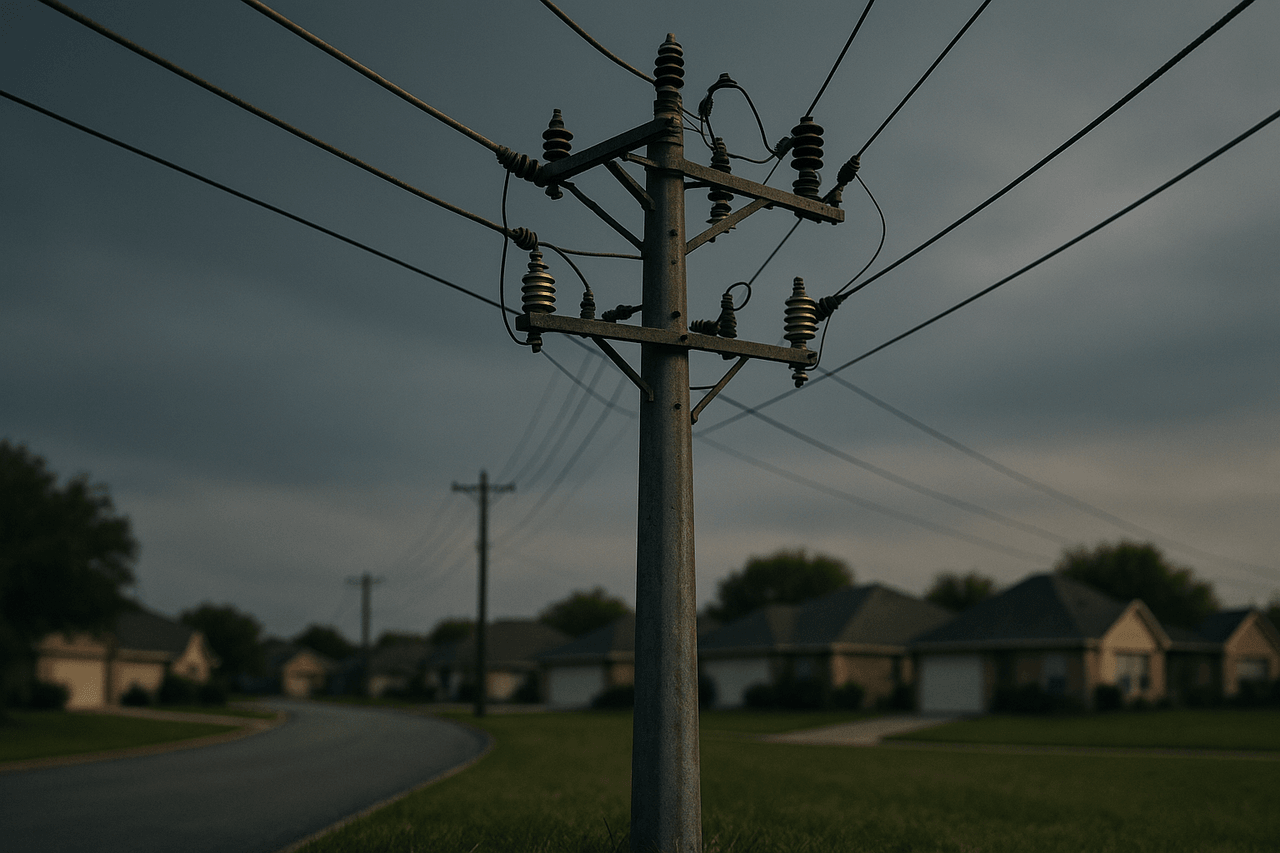
The second is the regulated wires business. Transmission and distribution utilities (TDUs) own and maintain the physical power lines, poles, transformers, and meters. They do not sell electricity. Their only job is to move power from the wholesale grid to your home reliably and safely. The Public Utility Commission of Texas (PUCT) sets the rates they are allowed to charge, so there is no competition among TDUs. Each utility holds a geographic monopoly.
These two systems share the same infrastructure. A REP schedules and pays for the electricity you use. The TDU delivers it. When you pay your monthly bill to your REP, a portion of that bill is actually a pass-through charge the REP pays to the TDU on your behalf. Those charges show up on your bill under names like "delivery charges," "transmission and distribution charges," or simply "TDU fees."
Which Utility Serves Your Address
Four major TDUs serve the deregulated portions of Texas. Your address determines which one applies to you, and you have no say in that assignment.
Oncor Electric Delivery serves the Dallas-Fort Worth metroplex and a wide band of North and West Texas, covering more than 13 million Texans. It is the largest TDU in the state by customer count.
CenterPoint Energy serves the Houston metropolitan area, including most of Harris County and surrounding communities.
AEP Texas operates two separate service territories. AEP Texas Central covers Corpus Christi, the Rio Grande Valley, and surrounding South Texas. AEP Texas North covers Abilene, San Angelo, Vernon, and surrounding West Texas communities.
Texas-New Mexico Power (TNMP) serves scattered pockets of Texas, including West Texas towns such as Pecos and Fort Stockton, North-Central Texas around Lewisville and Glen Rose, and Gulf Coast communities south of Houston such as Texas City, League City, Friendswood, Alvin, and Angleton.
A fifth entity, Lubbock Power and Light, completed its migration to the ERCOT grid in December 2023, and ERCOT confirmed the completion of Lubbock's transition to retail competition in April 2024. LP&L now operates as a wires-only utility, and Lubbock customers shop for a retail provider like other Texans in competitive areas. Consumers in Lubbock should confirm their status directly with that utility.
If you are unsure which TDU serves your address, your current electricity bill states it. You can also enter your service address or ZIP code on the PUCT's official Power to Choose website, which identifies the TDU serving your address.
What TDUs Charge and How It Affects Your Bill
TDU delivery charges are one of the most misunderstood components of a Texas electricity bill. They are not controlled by your REP, and switching retail providers does not change them.
A typical delivery charge from a major Texas TDU includes a fixed monthly customer charge (often ranging from roughly $3 to $8 per month depending on the utility) plus a per-kWh energy delivery charge. Because the fixed portion does not scale with usage, TDU fees represent a higher percentage of the bill for low-usage households than for high-usage ones.
This structure contributes directly to one of the more consequential features found in Texas retail plans. In Choose My Power's own plan listing, a first-party snapshot that refreshes daily and is not independently audited, 16 of the 123 plans live on October 19, 2026 carried a bill-credit cliff, meaning a household using 500 kWh in a month pays $25 or more above what a household using 1,000 kWh would pay on the same plan. Part of the reason that math works the way it does is that many retail plans are engineered around the fixed-cost structure of TDU delivery fees.
Who to Call When the Power Goes Out
This is a point that causes genuine confusion: when your power goes out, you do not call your retail electricity provider. You call your TDU.
REPs schedule power and handle billing. They do not own trucks, do not employ line crews, and cannot restore service to your address. The TDU's crews are the ones who respond to outages, repair downed lines, replace blown transformers, and restore power after storms. Your TDU's outage hotline should be in your phone before an emergency, not something you search for in the dark.
Oncor outage line: 888-313-4747. CenterPoint outage line: 800-332-7143. AEP Texas outage line: 866-223-8508. TNMP outage line: 888-866-7456.
Your REP cannot speed up the restoration process. Calling them during an outage wastes time you could spend calling the TDU.
The ERCOT Connection
The Electric Reliability Council of Texas (ERCOT) sits above both the TDUs and the REPs. ERCOT is the independent system operator that manages the flow of electricity across the high-voltage transmission grid serving about 90 percent of the state's electric load, covering roughly 75 percent of Texas's land area. It dispatches power plants, monitors grid stability in real time, and settles the wholesale transactions that REPs use to buy the electricity they then sell to you.
TDUs own the lower-voltage distribution lines from the transmission system to your home. ERCOT manages the transmission system itself, though the high-voltage transmission lines are also owned by TDUs and other transmission-only companies operating under PUCT oversight.
This three-layer structure, ERCOT at the top managing the bulk grid, TDUs in the middle operating local delivery infrastructure, and REPs at the retail level facing the consumer, is what makes Texas electricity markets work the way they do. Competition lives only in that third layer. The first two are regulated monopolies.
Why This Structure Matters When You Shop for a Plan
Knowing how Texas power lines work changes how you read an electricity offer.
First, the TDU delivery charges in your area are a cost floor. No retail plan can eliminate them. The cheapest plan listed on Choose My Power as of October 19, 2026 was APGE's SimpleSaver 9, posted at 6.6 cents per kWh all-in at 1,000 kWh in the lowest-cost utility area. That figure is only possible because the plan carries a monthly bill credit that applies when usage reaches 1,000 kWh: regulated TDU delivery alone runs roughly $59 to $85 at that usage depending on the territory, and the same plan works out to about 19.5 cents per kWh at 500 kWh, where the credit does not apply. Comparing that to the median listed rate of 14.9 cents per kWh at the same usage level shows meaningful variation, but part of what drives that variation is which TDU territory a household sits in.
Second, when plans advertise an all-in rate, that rate already includes the TDU pass-through. When plans advertise an energy charge only, the TDU delivery fee is added on top. Reading the Electricity Facts Label (EFL) for any plan, which is a standardized disclosure required by the PUCT, will show you both components clearly.
Third, switching retail providers is straightforward and does not involve the TDU at all. No technician visits are required, no wires are moved. The TDU simply receives updated scheduling information. Switching is a billing change, not a physical change.
Understanding the line between what your REP controls and what your TDU controls is not a minor technical detail. It determines who is responsible when something goes wrong, where your rate savings can and cannot come from, and how to read the documents that govern your electricity contract.