
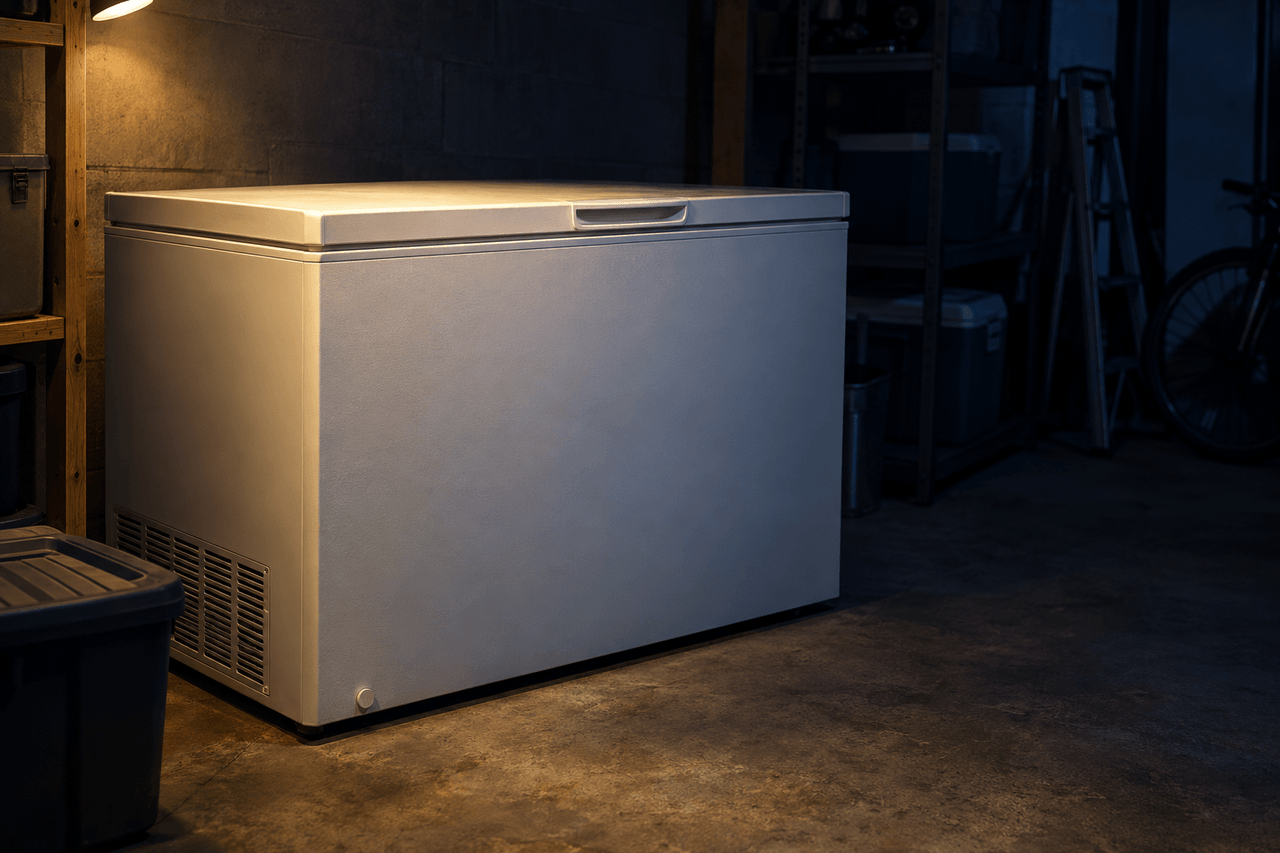

A typical standalone freezer uses between 100 and 400 kilowatt-hours per year, which translates to roughly $15 to $60 annually at median Texas rates, but an older or oversized unit can quietly double that figure. Before shopping for a new electricity plan, it helps to know exactly what your freezer is pulling, because the math changes depending on your total monthly usage in ways that are not always obvious.
How Many Watts Does a Freezer Use?
Freezer wattage falls into two numbers: running watts and starting watts. The compressor cycles on and off throughout the day, so the freezer is not drawing its peak load continuously.
- Compact freezers (up to 5 cubic feet): 30 to 100 watts running
- Mid-size chest or upright freezers (5 to 15 cubic feet): 100 to 200 watts running
- Large chest or upright freezers (15 to 25 cubic feet): 150 to 400 watts running
- Commercial-style deep freezers: 300 to 600 watts running
Starting watts can spike two to three times the running wattage for a fraction of a second when the compressor kicks on. That spike matters for generator sizing, but it does not affect your monthly bill in any meaningful way.
The Federal Trade Commission (FTC) requires manufacturers to publish annual energy consumption estimates, based on Department of Energy test procedures, on the yellow EnergyGuide label. That label figure is the most reliable starting point. A modern ENERGY STAR-certified chest freezer uses about 215 kWh per year on average, though certified models around 15 cubic feet run closer to 280 to 350 kWh per year. A non-certified unit of the same size from 2005 might consume 350 to 450 kWh per year.
Deep Freezer Electricity Usage vs. Refrigerator-Freezer Combos
A dedicated deep freezer is almost always more efficient per cubic foot than the freezer compartment inside a refrigerator-freezer combo. The reason is straightforward: chest freezers lose less cold air when opened because cold air sinks and stays in the chest. Upright freezers and refrigerator compartments lose cold air through the door every time it opens.
That said, running a second appliance in a garage or utility room adds to your total monthly consumption regardless of its per-cubic-foot efficiency. The question is not whether the freezer is efficient in isolation, but whether your overall bill structure rewards or penalizes higher usage.
Why Your Rate Plan Structure Matters
Texas electricity plans are not uniformly priced. Many plans sold in the deregulated market include bill credits that trigger only at specific usage thresholds, most commonly 1,000 kWh or 2,000 kWh per month. If your household normally uses 980 kWh and a garage freezer adds 30 kWh, you might cross a threshold and see your effective rate drop. Alternatively, if your plan has a punishing rate tier above 1,000 kWh, that same freezer could cost you more than the raw kWh price suggests.
A sizable share of Texas offers are built around bill credits that apply only at or above a set usage level (most often 1,000 kWh), so on those plans the monthly bill at 500 kWh can land tens of dollars above the bill at the same plan's 1,000 kWh price point. Where that is true, running a freezer that pushes you closer to the credit threshold actually works in your favor. On a flat-rate plan, the freezer costs exactly what its kWh consumption multiplied by the rate implies.
The U.S. Energy Information Administration puts the average Texas residential electricity price at 15.9 cents per kWh (July 2026, the most recent month published). At that rate, a freezer consuming 300 kWh per year adds about $48 to your annual bill, or roughly $4 per month.
How to Measure Your Freezer's Actual Electricity Usage
The EnergyGuide label gives a good estimate, but your specific conditions may differ. Garage temperatures in Texas summers can exceed 100°F, which forces the compressor to run longer. A freezer stuffed to capacity retains cold better than a half-empty one. Age and seal condition also shift the real number.
The most reliable method is a plug-in energy monitor. Devices like the Kill A Watt P4400 (available at most hardware stores for $25 to $35) plug into the wall outlet, and the freezer plugs into the monitor. After seven to fourteen days, the monitor displays total kWh consumed. Multiply by 52 (if you measured a week) or 26 (if you measured two weeks) to get an annual estimate.
Step-by-step:
- Plug the energy monitor into the outlet. Plug the freezer into the monitor.
- Reset the monitor to zero.
- Leave the freezer running under normal conditions for at least seven days. Do not open it more or less than usual.
- Read the kWh figure on the monitor.
- Multiply by the appropriate factor (52 for a one-week reading, 26 for two weeks) to get estimated annual consumption.
- Multiply annual kWh by your plan's effective rate to get annual cost.
If you cannot access the outlet easily or the freezer is hard-wired, your utility's smart meter data is the next best option. In Texas, most Oncor, AEP Texas, CenterPoint, and TNMP customers can download 15-minute interval usage data through the shared Smart Meter Texas portal at smartmetertexas.com. Unplug the freezer for 24 hours, note the drop in consumption versus a comparable prior day, and use that delta as a daily estimate.
What Drives Freezer Electricity Usage Higher
Several factors push consumption above the EnergyGuide estimate:
Ambient temperature. A freezer in an unconditioned Texas garage runs significantly harder in July than in January. Lawrence Berkeley National Laboratory analysis of residential refrigeration products estimates roughly a 3 percent change in electricity use per 1°F change in ambient temperature at a 30°F appliance-to-room gradient; a deep freezer's wider gradient softens that percentage, but a unit in a 90°F garage still draws materially more power than the same unit at 70°F.
Thermostat setting. Most freezers should be set to 0°F. Every 10 degrees colder than necessary adds roughly 10 to 15 percent to energy consumption.
Frost buildup. Manual-defrost chest freezers require periodic defrosting. More than a quarter-inch of frost on the interior walls acts as an insulator and makes the compressor work harder.
Age and seal condition. Door gaskets on freezers older than ten to fifteen years often lose their seal. A simple test: close the door on a piece of paper. If the paper slides out with little resistance, the gasket needs replacement.
Fill level. A mostly empty freezer loses cold air more easily when opened and has less thermal mass to stabilize temperature. Filling empty space with jugs of water helps maintain efficiency.
When Replacing the Freezer Makes Financial Sense
If the energy monitor shows your older freezer consuming 500 kWh or more per year, replacement math becomes worth running. At the EIA's 15.9-cent Texas average, 500 kWh costs about $80 per year. A modern ENERGY STAR chest freezer at 215 kWh per year would cost about $34, saving roughly $46 annually. A new unit retails for $200 to $400, so the payback period runs roughly four to nine years, reasonable if the old unit is already showing mechanical wear.
If the freezer is in good mechanical condition and simply older, improved gaskets, proper thermostat settings, and moving it indoors (if feasible) can recover a meaningful share of the efficiency gap without capital cost.
Putting the Freezer Number into Your Broader Bill
Freezer electricity usage is one line in a larger equation. Knowing the number precisely lets a household compare it against other loads (a window AC unit, an electric water heater, a pool pump) and prioritize efficiency investments accordingly. It also feeds directly into the usage-threshold analysis that determines whether switching plans or adjusting consumption habits would produce net savings.
The pillar guide on measuring your usage at Choose My Power walks through how to aggregate appliance-by-appliance estimates into a monthly total and cross-reference that total against the plan structures available in your service area. The freezer figure calculated here belongs in that broader picture.