
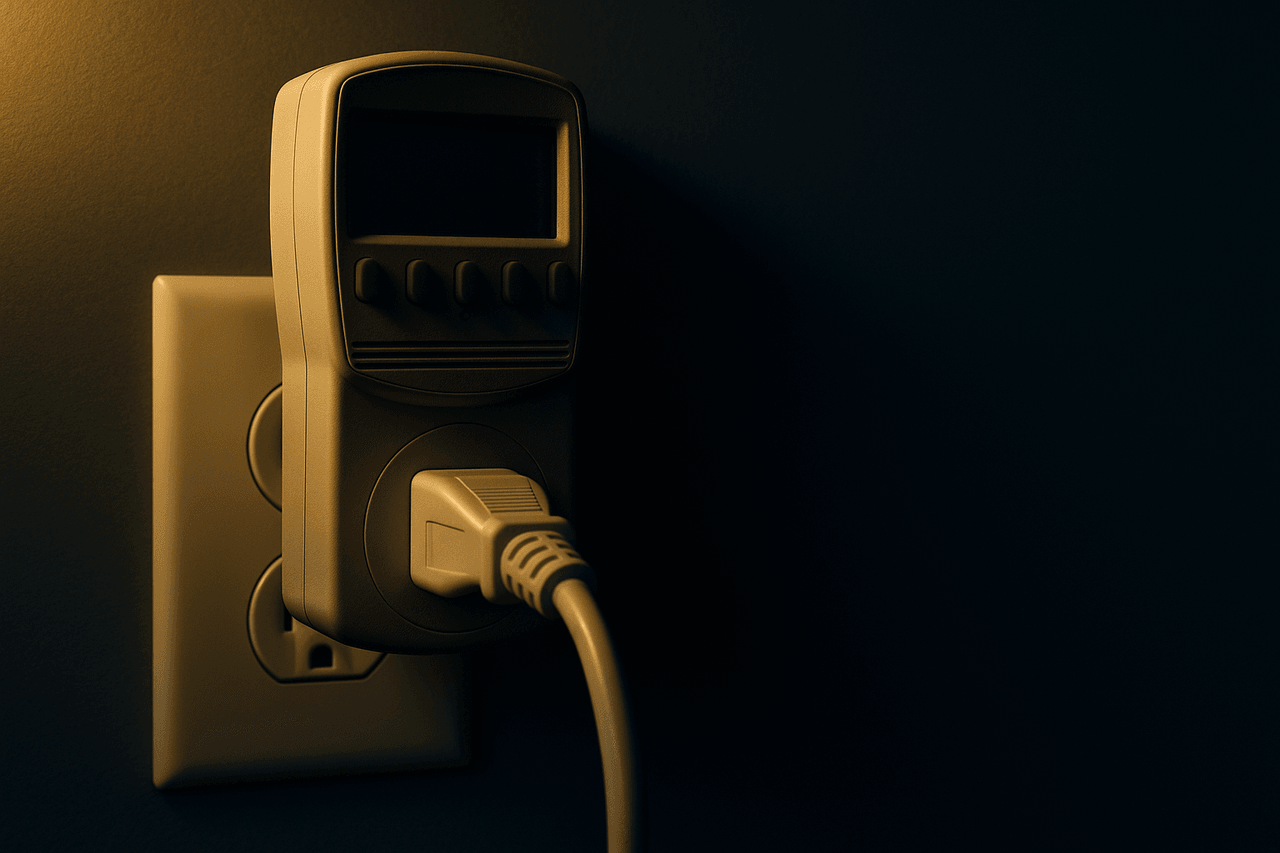

The single fastest way to find wasted electricity in a Texas home is to plug a usage monitor into every major appliance and read what it says.
Most households guess at which devices drive their bill. An electricity usage monitor removes the guessing. It measures real watts in real time, converts that into kilowatt-hours over days or weeks, and often calculates the dollar cost directly. That data matters because Texas retail electricity plans price every kilowatt-hour you consume, and some plans include pricing structures that make high-use months disproportionately expensive.
What an Electricity Usage Monitor Actually Does
An electricity usage monitor is a small device, typically a pass-through plug, that sits between an appliance and the wall outlet. The appliance draws power through the monitor, which measures current and voltage continuously. From those two measurements the device calculates watts (the rate of consumption) and accumulates kilowatt-hours (the total energy used over time).
The display shows some combination of the following:
- Watts -- the instantaneous draw at that moment
- Kilowatt-hours -- the running total since you started the measurement
- Cost -- calculated from a rate you enter manually
- Projected monthly cost -- an extrapolation based on current usage patterns
- Power factor -- relevant for motors and compressors, less so for resistive loads like toasters
The kilowatt-hour figure is the one that maps directly to your electricity bill. Everything else is supporting context.
Which Type of Monitor to Use
Three types cover most household needs.
Plug-in pass-through monitors handle individual outlets. The Kill A Watt P4400 is the category reference point, widely available for under $30. It works for 120-volt plug-in devices drawing up to 15 amps, or about 1,800 watts. It does not work for 240-volt appliances such as electric dryers, HVAC systems, or electric water heaters.
Clamp-style current transformers clip around the wires feeding a circuit breaker without interrupting the circuit. Installing them means opening a live breaker panel, and manufacturers such as Emporia recommend that the work be done by a licensed electrician or other qualified professional in accordance with local electrical code. These handle 240-volt circuits and are the right tool for measuring a central air conditioner or an electric range.
Whole-home energy monitors attach to the main service entrance inside the breaker panel. Brands such as Emporia Vue use current transformers on every circuit or on the main feeds, then send data to a phone app. They show total home consumption in real time, and the better models attempt to disaggregate individual appliances through machine learning. Whole-home monitor hardware runs roughly $100 to $300, plus electrician labor if you do not install it yourself. They are useful for households that want continuous monitoring rather than a one-time appliance audit.
For most households running a first audit, a $25 plug-in monitor covers 80 percent of the useful measurements.
How to Measure an Appliance Correctly
The procedure is straightforward, but two common mistakes produce useless data.
Mistake one: measuring for too short a period. A refrigerator compressor cycles on and off. Measuring for five minutes may catch it running at 150 watts or idling at 5 watts. Neither figure is representative. Leave the monitor in place for at least 48 hours to capture a realistic average.
Mistake two: entering the wrong rate. Most monitors let you set a price per kWh for cost calculations. Use the all-in rate from your Electricity Facts Label, not the base energy charge alone. Texas plans bundle transmission, distribution, and various fees into the per-kWh figure on the EFL, and your cost estimate will be wrong if you omit those components. If you are unsure of your all-in rate, divide your last bill's total charges by the kWh consumed that month.
The correct procedure:
- Plug the monitor into the outlet.
- Plug the appliance into the monitor.
- Set the cost rate using your actual all-in rate.
- Zero the kWh counter.
- Leave it in place for 48 to 72 hours without interrupting the measurement.
- Record the kWh total and the projected monthly cost.
- Move to the next appliance.
For a 240-volt appliance using a clamp meter, the same time window applies. Measure across a full operating cycle, not a snapshot.
What the Numbers Reveal
Once measurements are complete, a clear picture usually emerges quickly. In Texas homes, the three largest consumers are typically central air conditioning, electric water heating, and the refrigerator. A central HVAC system in a mid-size Texas home commonly uses roughly 600 to 1,500 kWh per month during peak summer, depending on system age, insulation quality, and thermostat settings. An electric resistance water heater often runs 300 to 500 kWh per month. A ten-year-old refrigerator typically consumes about 45 to 60 kWh per month, while a current Energy Star model may use 30 to 50 kWh.
Those are general ranges. The monitor gives the household-specific figure, which is the only number that matters for calculating payback on an upgrade.
Connecting Measurements to Your Plan
Usage data is most valuable when it informs plan selection. Texas retail plans price differently at different consumption levels, and the gap is not trivial.
As of October 5, 2026, the cheapest plans listed on Choose My Power priced out near 6.6 cents per kWh at 1,000 kWh -- APGE's SimpleSaver 12 sat at that level in its lowest-cost utility area -- against a site-wide median in the mid-14-cent range across 125 listed plans. That 6.6-cent figure is not a flat energy rate. SimpleSaver 12 is a bill-credit plan: a $125 credit applies in any billing cycle that reaches 1,000 kWh, which pulls the average price down sharply at exactly that usage level, and the same plan prices out near 19.5 cents per kWh at 500 kWh. Posted rates move daily and vary by utility area, so confirm any figure on the plan's current EFL before enrolling. A household that measures its actual monthly kWh can look up its cost on any plan's EFL at the closest of the three usage levels every label must show -- 500, 1,000, and 2,000 kWh -- rather than relying on the 1,000 kWh benchmark figure that providers are required to display but that may not match the household's real consumption.
The usage measurement also helps identify whether a household is at risk from bill-credit structures. Sixteen of the 125 plans listed on Choose My Power as of October 5, 2026, carry a bill-credit cliff: the bill at 500 kWh runs $25 or more above the bill at 1,000 kWh on the same plan. Most Texas bill credits apply only in billing cycles that reach the plan's threshold -- commonly 1,000 kWh, though some plans set it at 500, 800, or 2,000 kWh -- so a household that measures 700 kWh in spring and 1,400 kWh in August would earn the credit in August and lose it every spring month, landing on the expensive side of that cliff for much of the year. Only a household that clears the threshold in all twelve months avoids it. A household that consistently uses 550 kWh would pay a significant penalty on those plans. The monitor makes that distinction concrete.
When to Skip the Monitor and Go Straight to the Bill
A usage monitor is not always the right starting point. If a household has twelve months of utility bills available, the monthly kWh figures are already printed on each statement, and the year-over-year pattern is visible without any additional hardware. The monitor adds value when the goal is appliance-level attribution, not when the goal is simply knowing total monthly consumption.
Similarly, if a household's bill has risen sharply and the cause is obviously a rate increase rather than a behavior change, the monitor will not address the root problem. In that case, comparing current plan rates against available alternatives is the correct first step.
A Practical Audit Sequence
For a household conducting its first audit, this sequence produces useful results within two weeks:
- Pull the last 12 months of bills and note the kWh total for each month.
- Identify the two or three months with the highest consumption.
- Use a plug-in monitor to measure the refrigerator, freezer, and any window AC units over 48 hours each.
- Use a clamp meter or whole-home monitor to measure the central HVAC system and water heater over a full week.
- Compare the sum of individual appliance measurements against the total bill kWh. The gap is everything else: lighting, devices on standby, cooking, and miscellaneous loads.
- Prioritize any appliance whose monthly cost exceeds $20 per month as a candidate for efficiency improvement or behavioral change.
The output of that process is a ranked list of consumption sources tied to real dollar costs. That list, combined with current plan pricing, gives a household the information it needs to make electricity decisions based on evidence rather than estimates.