
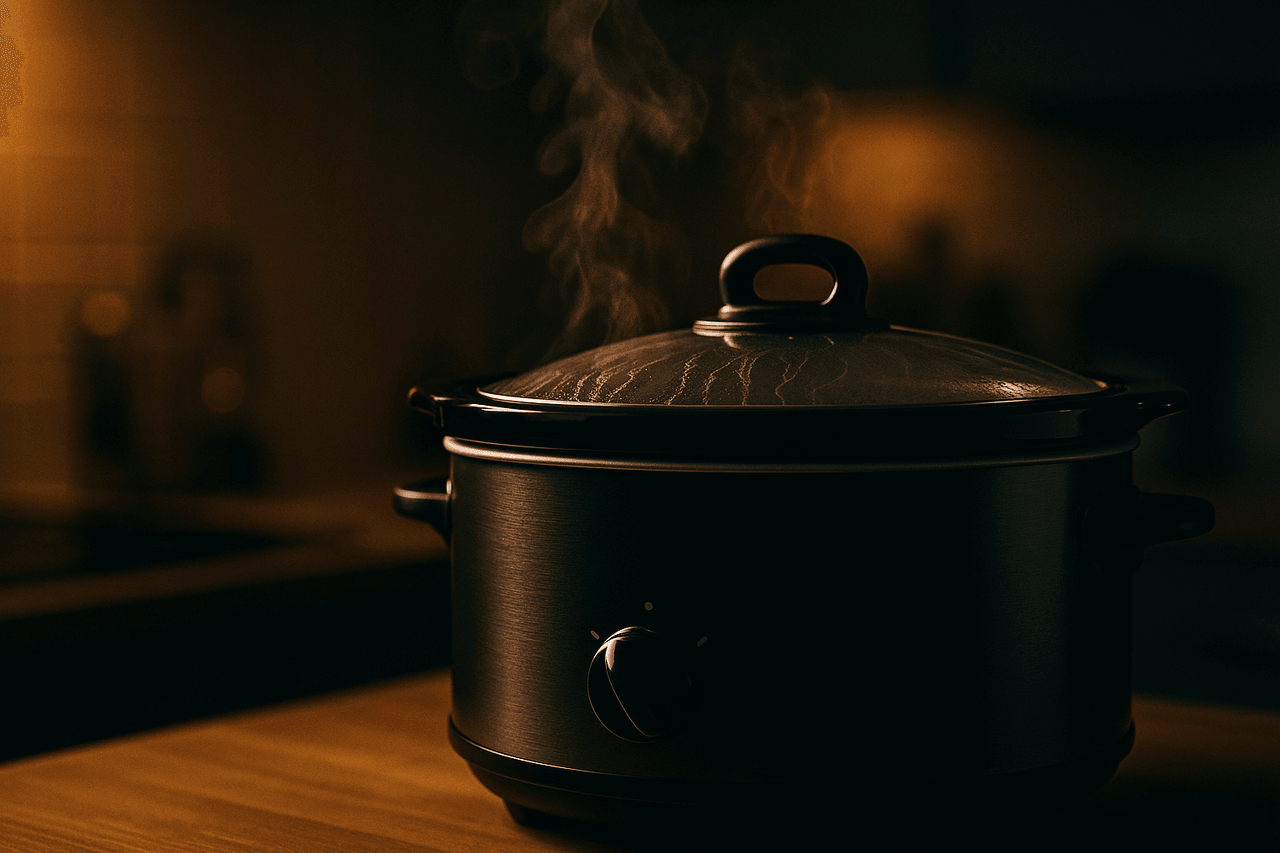

A crock pot uses between 45 and 300 watts depending on the setting and model, making it one of the lower-draw cooking appliances in a Texas kitchen, but an eight-hour cook cycle can still add up in ways most households do not expect.
Understanding exactly how much electricity a slow cooker draws, and how that compares to an Instant Pot or a conventional oven, gives households a clearer picture of where cooking costs sit on their monthly bill.
How Many Watts Does a Crock Pot Use?
Most standard crock pots operate in a wattage range that depends on two factors: the size of the unit and the heat setting selected.
- By setting (manufacturer figure): Crock-Pot states that its slow cookers use between 45 and 150 watts on LOW and between 150 and 210 watts on HIGH, the language it publishes on the product page for the 4-quart Classic and repeats as general guidance across the line.
- By size (nameplate rating): rated wattage climbs with capacity. Small 1- to 3-quart units generally land around 70 to 150 watts, medium 4- to 5-quart units around 120 to 210 watts, and large 6- to 8-quart units around 200 to 300 watts, with some 8-quart models higher.
The wattage printed on the bottom or back label of the unit reflects the maximum draw at the High setting. When a crock pot cycles its heating element on and off to maintain temperature, which is normal operation, the average wattage over the full cook period is typically 20 to 30 percent lower than the stated maximum.
The U.S. Department of Energy's Energy Saver guidance on kitchen appliances recommends using small electric pans, toaster ovens, or convection ovens instead of a full-size stove or oven for small meals, and states that a toaster or convection oven uses one-third to one-half as much energy as a full-sized oven (DOE, Energy Saver: Kitchen Appliances). The DOE page does not publish a slow-cooker-specific figure, but the same logic applies here: a crock pot's heating element is rated at a small fraction of an oven's wattage and cycles on and off to hold temperature, so a full eight-hour run on a small or medium unit usually consumes less total electricity than an hour of oven baking. The margin is narrower than it looks, though: both appliances cycle rather than drawing rated wattage continuously, and a large cooker held on High for eight hours can reach roughly 2.4 kWh, the same territory as an hour of oven use.
Slow Cooker Electricity Usage: Calculating the Real Cost
Wattage alone does not determine cost. The formula that matters is:
kilowatt-hours (kWh) = watts divided by 1,000, multiplied by hours of use
For a 200-watt crock pot (a medium-to-large unit drawing its rated wattage, which is a High-setting figure, so this is an upper bound) running eight hours:
200 watts / 1,000 = 0.2 kW 0.2 kW x 8 hours = 1.6 kWh per cook session
At the median listed rate on Choose My Power as of October 12, 2026 (14.8 cents per kWh across 127 plans from 17 providers, quoted as Electricity Facts Label average prices at 1,000 kWh of monthly usage, the all-in figure that includes TDU delivery charges), that single eight-hour cook session costs roughly 24 cents. For context, the EIA's statewide average residential price in Texas has run in the mid-15- to 17-cent range through 2026.
Run the slow cooker five days a week for a month and the total comes to about $5.18 per month at that median rate. At the lowest listed plan rate on Choose My Power as of the same date, 6.8 cents per kWh (APGE SimpleSaver 9 in the lowest-cost utility area), the same usage would price out at roughly $2.38 per month. That 6.8 cents is an average price at 1,000 kWh that depends on a bill credit landing, however, so it is not the marginal cost of the next kWh on that plan. On bill-credit structures the effective price swings sharply above and below the reference usage level.
The gap between those two outcomes, roughly $2.80 per month on one appliance, illustrates why the all-in rate a household actually pays per kWh, not the headline rate on a comparison page, shapes everyday appliance costs, not just large HVAC or water heater loads.
How Many Watts Does an Instant Pot Use?
The Instant Pot is the most common alternative to a slow cooker for one-pot meals, and its energy profile is meaningfully different.
Most Instant Pot models are rated between 700 and 1,200 watts. The most widely owned model, the Instant Pot Duo 6-quart, carries a 1,000-watt rating (Instant Pot product specifications). However, the Instant Pot runs at or near its rated wattage only while building pressure, then cycles the element to hold it, so average draw across a full cycle is well below the nameplate figure. Metered tests put it in the low hundreds of watts for ordinary loads.
Rated wattage is the wrong starting point here, because a real cycle includes several minutes at or near 1,000 watts to build pressure. Metered figures are better. A Modern Energy Cooking Services test of an Instant Pot recorded 0.25 kWh over a 44-minute cook, and an independent wattmeter test of a comparable 1,000-watt, 6-quart electric pressure cooker recorded about 0.20 kWh over 60 minutes. Heavier loads cost more: an academic kitchen comparison measured 0.42 kWh to pressure-cook a kilogram of potatoes in 20 minutes, and some vendor and utility estimates for a long roast cycle run to 1 kWh or above.
A reasonable planning range for a full 6-quart pressure-cooker cycle is therefore 0.2 to 0.5 kWh per session, with long or heavily loaded cooks landing above it.
At the median listed rate of 14.8 cents per kWh, that session costs roughly 3 to 7 cents.
The Instant Pot wins on energy per session. Against the crock pot's 1.6 kWh upper-bound session, a 0.2-to-0.5 kWh pressure-cooker cycle uses roughly 70 to 90 percent less electricity per meal.
Crock Pot vs. Oven vs. Instant Pot: A Side-by-Side View
Putting all three appliances in one place helps clarify the tradeoffs.
| Appliance | Typical Wattage | Typical Cook Duration | Estimated kWh per Session | Cost at 14.8 cents/kWh |
|---|---|---|---|---|
| Crock pot (medium, Low) | 45 to 150 W | 8 hours | 0.36 to 1.2 kWh | 5 to 18 cents |
| Crock pot (medium, High) | 150 to 210 W | 4 hours | 0.6 to 0.8 kWh | 9 to 12 cents |
| Instant Pot (6-qt) | 1,000 W peak | 45 min full cycle | 0.2 to 0.5 kWh | 3 to 7 cents |
| Conventional oven (350°F) | 2,000 to 2,400 W | 1 hour | 2.0 to 2.4 kWh | 30 to 36 cents |
Sources: Crock-Pot's published LOW and HIGH wattage ranges and manufacturer specification sheets; Instant Pot row from published metered test data; oven kWh and cost figures calculated from rated wattage and typical cook times.
The conventional oven has the highest cost per session among common cooking methods despite the shorter run time, because wattage at that level overwhelms the time savings. The Instant Pot costs the least per session. The crock pot on High for four hours lands between the two.
When the Slow Cooker Is the Smarter Choice
The energy math does not automatically make the Instant Pot the winner for every household. Several practical factors shift the calculation.
Unattended cooking. A crock pot requires no monitoring. A household that runs a crock pot during the workday and returns to a finished meal avoids oven preheat and post-work cooking stress. The extra kWh is the cost of that convenience.
Texture and recipe outcomes. Collagen-heavy cuts, dried beans, and soups often produce better results over eight hours at low heat than under pressure. If a recipe specifically benefits from low-and-slow cooking, using the Instant Pot to replicate it may not achieve the same result, making the comparison moot.
Time-of-use rate plans. Some Texas electricity plans charge lower rates during off-peak hours, often overnight or midday on weekdays. Running a crock pot from 7 a.m. to 3 p.m. on a time-of-use plan could reduce that 24-cent session cost considerably. Households on flat-rate plans do not benefit from this timing, but those on time-of-use structures should account for it.
How to Measure Your Specific Crock Pot
The wattage ranges above are reliable estimates, but every unit is different. The most accurate method for any household is a plug-in energy monitor, sometimes called a Kill A Watt meter, available at hardware stores for $20 to $30.
Plug the monitor between the outlet and the crock pot, run a full cook session, and read the kWh total directly. That figure, multiplied by the rate on the household's electricity plan, gives the precise cost per session. No estimation needed.
This same method works for any appliance a household suspects is contributing to a higher-than-expected bill. Identifying the actual draw of individual devices is one of the most direct ways to understand where monthly usage is coming from before looking at plan changes or rate comparisons.
What This Means for the Monthly Bill
Cooking appliances as a category represent a meaningful but not dominant share of a Texas household's electricity bill. The U.S. Energy Information Administration estimates that cooking accounts for roughly 1 to 2 percent of total residential electricity use in most households (EIA, Residential Energy Consumption Survey). The larger drivers remain HVAC, water heating, and always-on devices.
That said, understanding crock pot energy usage matters for two reasons. First, it builds the habit of thinking in kWh rather than in appliance labels, which is the skill needed to read a utility bill accurately. Second, households that are already close to a usage tier threshold on a tiered or bill-credit plan may find that small loads do affect their final cost more than the wattage suggests.
As of October 12, 2026, 16 of the 127 plans listed on Choose My Power carry a bill-credit cliff where a bill at 500 kWh runs $25 or more above the bill at 1,000 kWh. On those plans, every kWh of crock pot usage that keeps a household above the credit threshold has an outsized value. Knowing the draw of each appliance makes it possible to manage that threshold intentionally rather than by accident.