
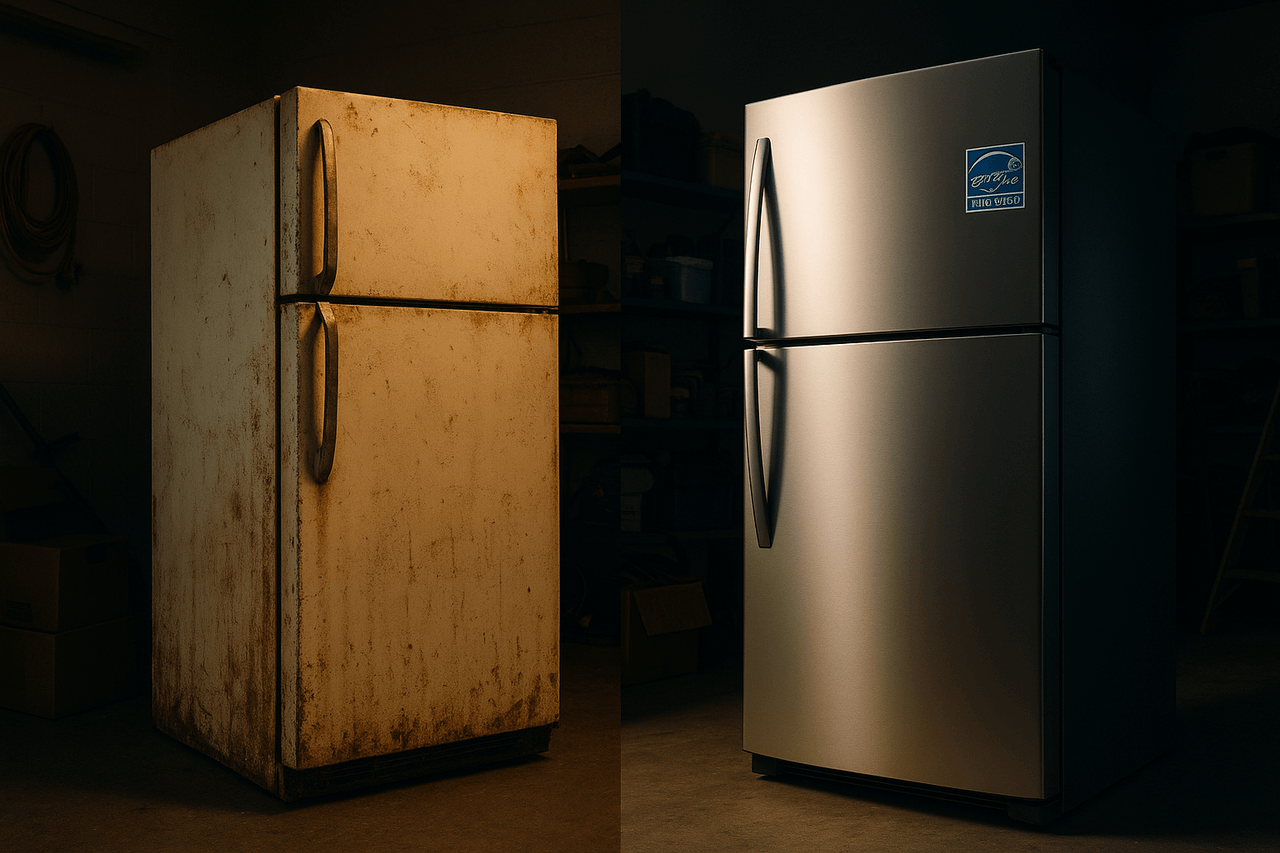

An old refrigerator running in a hot Texas garage can cost $200 or more per year in electricity alone, and refrigerators as a group account for about 7 percent of the electricity a typical U.S. home uses, according to the EIA. Before deciding whether to keep the old unit, plug a second one in, or replace it with a newer model, it helps to know the actual numbers.
Why Old Refrigerators Use So Much Power
Refrigerator efficiency has improved substantially over the past three decades. A typical full-size refrigerator built before 1990 used roughly 900 to 1,200 kWh per year. A comparable model sold in 2024 is rated closer to 400 to 500 kWh per year, partly because of federal efficiency standards that have tightened repeatedly since 1993.
The gap matters in dollar terms. At an assumed 14.8 cents per kWh (a figure near the low end of Texas pricing, since EIA-based reporting put the state's average residential rate at about 16.4 cents per kWh in 2026), a pre-1990 fridge consuming 1,100 kWh per year costs about $163 annually. A 2024 model consuming 450 kWh per year costs about $67. That is a $96 annual difference, before accounting for the additional heat load the old unit dumps into an unconditioned garage in summer.
The Garage Penalty
Most households with a second refrigerator keep it in the garage. That location creates a compounding efficiency problem in Texas. When ambient temperatures climb above 90°F, the compressor runs longer and harder to maintain the interior temperature. Nameplate kWh ratings come from a DOE laboratory test run at a 90°F ambient temperature, a condition DOE describes as standing in for typical room conditions of about 72°F with door openings. A garage that exceeds 110°F, which is common in Texas during July and August, sits well outside that test condition, so real consumption runs above the rating. No federal agency publishes a garage-specific penalty. The closest field evidence is metering work by the Florida Solar Energy Center, which found monitored refrigerators using roughly 20 percent more than their DOE label estimate under that state's warmer ambient conditions. Any percentage applied to a garage unit should be treated as an assumption, not a measurement.
Applying an illustrative 20 to 30 percent penalty across the full year to a 1,100 kWh baseline, a garage fridge in Texas would draw roughly 1,320 to 1,430 kWh annually. At 14.8 cents per kWh, that translates to roughly $195 to $212 per year, or $16 to $18 per month.
A newer Energy Star-certified unit placed in the same garage, consuming a base 450 kWh, would rise to roughly 540 to 585 kWh annually under the same penalty, costing $80 to $87 per year. The annual savings from switching: roughly $115 to $125.
How to Measure Your Specific Fridge
Manufacturer estimates and general averages are a starting point, not a substitute for measuring the actual unit. A plug-in energy monitor (sold at hardware stores for $25 to $30 under brands such as Kill A Watt) gives a reliable reading after 48 to 72 hours of measurement. The device displays total kWh consumed over the monitoring period. Multiply by the appropriate factor to annualize.
Steps:
- Plug the monitor between the fridge and the outlet.
- Let it run for at least 48 hours. A full 72 hours is better because compressor cycles vary.
- Read the kWh total from the monitor display.
- Divide by the number of hours monitored, then multiply by 8,760 to get annual kWh.
- Multiply annual kWh by your rate in cents per kWh, then divide by 100 to get annual cost in dollars.
Example: Monitor reads 4.2 kWh over 72 hours. Divide 4.2 by 72 to get 0.058 kWh per hour. Multiply by 8,760 to get roughly 511 kWh per year. At 14.8 cents per kWh, that is about $76 per year, roughly $6.30 per month.
If the monitor reading comes in above 1.5 kWh per day (547 kWh per year), the appliance is operating above the current federal limit for a standard-size unit, which works out to roughly 400 to 500 kWh per year for a typical top-freezer model, and the case for replacement strengthens considerably.
Old vs. New Fridge: A Simple Payback Calculation
A new 18- to 20-cubic-foot Energy Star refrigerator retails in the $700 to $1,100 range. The appliance payback calculation at Texas rates is straightforward.
Payback period (years) = Purchase price divided by annual savings.
Using a $900 purchase price and $120 in annual savings: 900 divided by 120 equals 7.5 years.
That is a reasonable payback for an appliance expected to last 15 years or more. The math improves if the old unit also requires a repair, or if the household is on a higher-rate plan. The math worsens if the old fridge is only moderately inefficient or if the household qualifies for a utility rebate that lowers the effective purchase price.
CenterPoint Energy runs the Texas Refrigerator Pick Up Program, which hauls away a working fridge or freezer of 7.75 cubic feet or larger from Houston-area residential customers and sends a $30 check, limited to one unit per service address (ESID). ARCA Recycling handles the pickup under contract with CenterPoint, and the check arrives four to six weeks after the appliance is collected. Other Texas wires companies have run similar recycling offers at various times, so it is worth contacting the utility serving the address to check current availability. Thirty dollars is modest, but against $120 in annual savings it trims roughly three months off the payback period.
Is a Second Refrigerator Worth It at All?
This is the question households often skip. The calculation above assumes the second refrigerator is needed. In many cases it is not, or it could be replaced by a smaller, more purpose-fit appliance.
A 24-can beverage cooler draws 100 to 200 kWh per year, a fraction of a full-size second fridge. For households using the garage unit mainly to store drinks and overflow items a few months per year, a cooler sized to actual need is far cheaper to operate.
For households using the second fridge regularly for meal prep, Costco runs, or food storage for a large family, the appliance earns its place. The question then becomes whether the specific unit earns its place, not whether the category does.
Where Your Electricity Rate Fits In
The cost calculations above use an assumed rate of 14.8 cents per kWh. That is modestly below the statewide picture. EIA-based reporting put the Texas average residential rate at about 16.4 cents per kWh in 2026, with the 2025 full-year average around 15.4 cents, so treat the dollar figures here as conservative and rerun them at the rate on the actual plan. Texas households on older, higher-rate plans may be paying 18 to 22 cents per kWh, which compresses the payback period significantly. Households who have recently switched to a competitive plan may be closer to the lower end of the market.
Be careful with the cheapest-looking plans, because the headline number is often an artifact of a bill credit rather than a real all-in price. Just Energy's Smart Choice - 12 is a clear example: its Electricity Facts Label shows a $125 credit that applies only when billed usage in a cycle meets or exceeds 1,000 kWh, sitting on top of a pass-through delivery charge of about 5.67 cents per kWh that the customer pays on every kilowatt-hour regardless. That structure makes the plan's average price swing sharply with usage, and it means the advertised figure at exactly 1,000 kWh is not the price the next kilowatt-hour actually costs. The extra kilowatt-hours a garage fridge adds are billed at the plan's energy and delivery charges, so run this math on those line items from the EFL, not on the marketing average. Even on a genuinely low fixed rate of 10 cents per kWh, a 1,400 kWh garage fridge costs about $140 per year, and the payback on a new appliance stretches past a decade. Rate context matters before committing to a purchase.
To find the actual rate on a current plan, look at the Electricity Facts Label (EFL) attached to the service agreement. Texas providers are required by the Public Utility Commission of Texas (PUCT) to publish EFLs for every plan. The rate at 1,000 kWh is the most useful figure for this kind of appliance cost calculation.
The Practical Bottom Line
An old refrigerator, especially one parked in a Texas garage, is often the single easiest appliance upgrade a household can make on payback grounds. The math favors replacement when the unit is from the mid-1990s or earlier, the household is paying close to the median Texas rate or above, and the appliance is used regularly enough to justify a full-size footprint.
The math does not automatically favor replacement for a mid-2000s unit in reasonable condition, a household on a below-median electricity rate, or a lightly used second fridge that could be downsized instead of replaced.
Measure first with an energy monitor, calculate the payback at the actual rate on the current plan, and check whether a utility recycling incentive is available. Those three steps take about a week and cost under $30. The decision is clearer after doing them.