
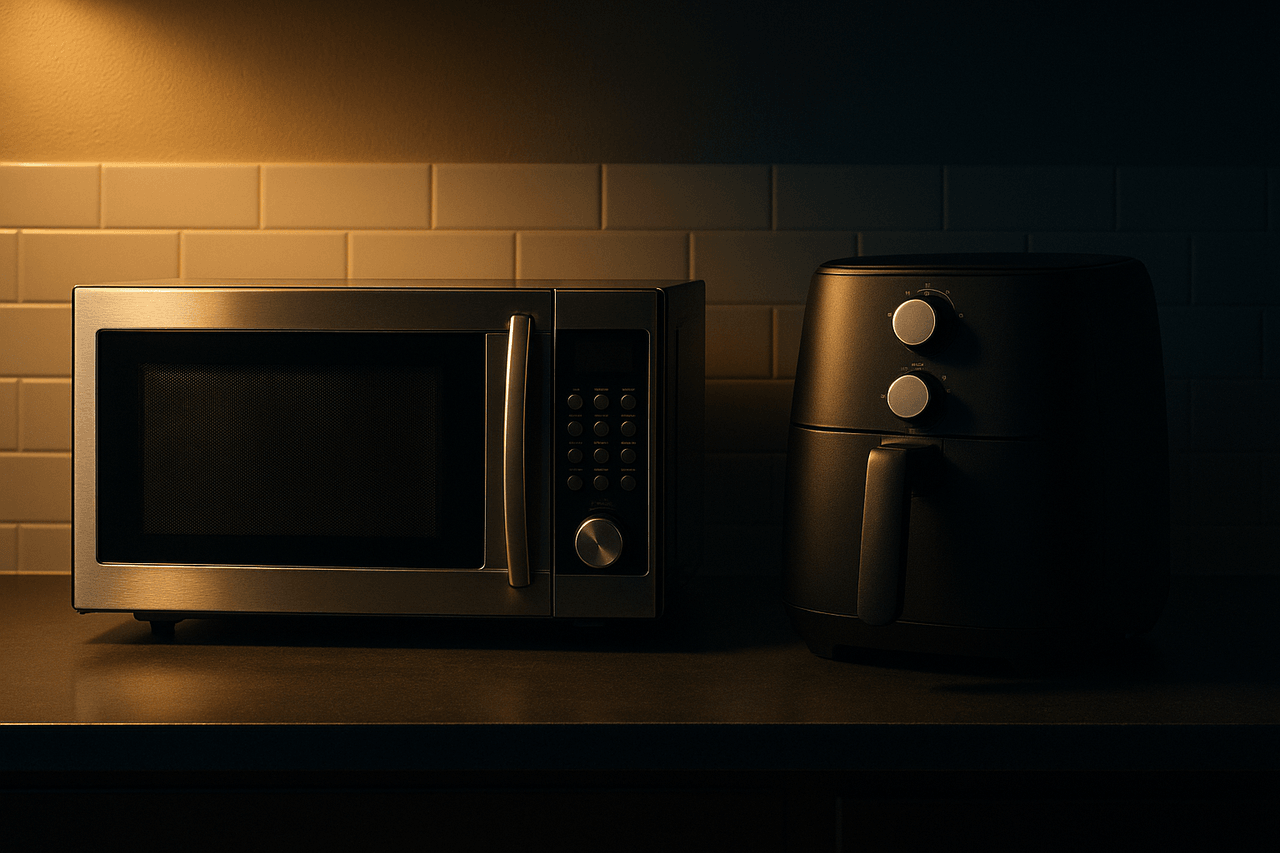

A standard countertop microwave delivers between 600 and 1,200 watts of cooking power, and a typical air fryer draws between 1,200 and 1,800 watts. But wattage alone does not tell you which appliance costs more to run. What matters is how many watt-hours each appliance consumes per cooking session, and then what you pay per kilowatt-hour on your Texas electricity plan. This article works through both questions with real numbers.
How Many Watts Does a Microwave Use?
Microwave ovens have two wattage ratings that are easy to confuse. The first is cooking power, which describes how much energy the magnetron delivers to food. The second is total power draw, which includes the magnetron plus the control panel, turntable motor, and interior light. Total draw runs roughly 40 to 50 percent higher than the cooking power printed on the door label.
Here is a practical breakdown by microwave category:
| Microwave type | Typical cooking power | Typical total wall draw |
|---|---|---|
| Compact (0.5 to 0.9 cu ft) | 600 to 800 W | 850 to 1,200 W |
| Mid-size (1.0 to 1.5 cu ft) | 900 to 1,100 W | 1,300 to 1,600 W |
| Full-size countertop (1.6+ cu ft) | 1,100 to 1,250 W | 1,550 to 1,800 W |
| Over-the-range models | 900 to 1,100 W | 1,300 to 1,600 W |
If the label on your microwave says 1,100 watts, plan on roughly 1,550 to 1,650 watts at the wall during active cooking. Standby mode, when the clock is displayed, draws roughly 1 to 2 watts continuously. That small idle draw adds up over a full year but is not the main cost driver for most households.
How Many Watts Does an Air Fryer Use?
Air fryers use a resistive heating coil and a high-speed fan to circulate hot air. Both components run simultaneously, which keeps wattage consistently high throughout the cooking cycle. Unlike a microwave, there is no meaningful gap between rated power and actual wall draw.
Typical air fryer wattage by size:
| Air fryer size | Typical wall draw |
|---|---|
| Compact (1 to 2 qt) | 1,000 to 1,200 W |
| Standard basket (3 to 5 qt) | 1,400 to 1,700 W |
| Large basket or dual-zone (6 to 9 qt) | 1,700 to 1,800 W |
| Full-size air fryer oven | 1,500 to 1,800 W |
A 5-quart air fryer, the most common household size, draws around 1,500 watts. That is noticeably higher than a mid-size microwave, but the relevant question is how long each appliance actually runs.
Watt-Hours Are What You Pay For
Your electricity bill charges by the kilowatt-hour (kWh), not by the watt. One kilowatt-hour equals 1,000 watts running for one full hour. A higher-wattage appliance used for a shorter time can cost less than a lower-wattage appliance running longer.
The formula is straightforward:
kWh = (watts x minutes of use) / 60,000
Applied to common scenarios:
- Microwave, 1,200 W, 5 minutes: (1,200 x 5) / 60,000 = 0.10 kWh
- Air fryer, 1,500 W, 15 minutes: (1,500 x 15) / 60,000 = 0.375 kWh
- Air fryer, 1,500 W, 25 minutes: (1,500 x 25) / 60,000 = 0.625 kWh
Using a representative mid-market Texas rate of 14.9 cents per kWh (roughly where competitive 12-month fixed plans were clustering in September 2026, and a little below the EIA statewide Texas residential average of about 16 cents), those sessions cost approximately:
- Microwave, 5 minutes: $0.015 (about 1.5 cents)
- Air fryer, 15 minutes: $0.056 (about 5.6 cents)
- Air fryer, 25 minutes: $0.093 (about 9.3 cents)
No single cooking session is a budget emergency. The cost becomes meaningful when you add up daily use over a month. A household that air-fries for 20 minutes every day pays roughly $0.075 per day at that representative rate, or about $2.25 per month from that appliance alone. A microwave used 10 minutes per day adds closer to $0.90 per month.
Microwave vs. Air Fryer: A Direct Cost Comparison
For tasks where both appliances can do the job (reheating leftovers, cooking frozen vegetables, warming a small portion) the microwave is almost always cheaper per session because it finishes faster. A microwave reheats a plate of food in 2 to 4 minutes. An air fryer doing the same job for crispness takes 8 to 12 minutes and draws more watts the entire time.
For tasks where only the air fryer produces the desired result (crispy chicken, evenly browned fries, roasted vegetables with a caramelized exterior) the comparison is not really appliance-vs-appliance. It is air fryer versus oven. On that comparison, the air fryer wins clearly. A conventional electric oven element draws 2,000 to 5,000 watts (including preheat), and it takes far longer to cook a small portion than an air fryer does. Using a 1,500-watt air fryer for 20 minutes consumes 0.5 kWh. Preheating and running a full-size oven for the same task typically consumes 1.0 to 1.5 kWh.
How Your Texas Rate Multiplies These Numbers
The per-session numbers above used 14.9 cents per kWh as a representative mid-market rate, not a statewide average; the EIA put the Texas residential average nearer 16 cents in mid-2026. Texas rates vary considerably. The cheapest plans advertised on Texas comparison sites in late September 2026 showed headline prices of roughly 6.4 to 7.2 cents per kWh at exactly 1,000 kWh of monthly usage, and those floor prices appeared in more than one TDU area, about 6.6 cents in the Oncor (Dallas) area and about 7.0 cents in the CenterPoint (Houston) area. Many of those offers are bill-credit or usage-threshold plans. Miss the usage threshold in a given month and the effective rate rises sharply. Straight fixed-rate plans without that structure cluster closer to 12 to 15 cents, and expensive plans run well above 20 cents.
The multiplier effect is real. At 6.6 cents (the kind of headline rate advertised at exactly 1,000 kWh, often on a plan with a usage-credit threshold) that 20-minute daily air fryer habit costs about $1.00 per month. At 20 cents, it costs about $3.00 per month. Neither figure is alarming for a single appliance. But the rate difference compounds across every appliance in the home, every hour of HVAC operation, and every load of laundry. A household running on a 20-cent plan and switching to a 6.6-cent plan does not save $2.00 per month. It saves that margin multiplied across hundreds of kWh.
That is why appliance wattage conversations connect directly to plan selection. Knowing your microwave uses 0.10 kWh per session is useful. Knowing your plan rate is useful. Together, they tell you what your habits actually cost.
Practical Tips for Reducing Appliance Electricity Costs
Match the appliance to the task. Use the microwave for reheating and defrosting. Use the air fryer when texture matters and the oven would otherwise be the alternative. Avoid using the air fryer as a substitute microwave.
Check wattage before buying. A compact air fryer at 1,000 watts costs meaningfully less per session than a large dual-zone model at 1,800 watts. If you cook small portions, smaller capacity is not a compromise. It is an efficiency choice.
Account for standby draw. Appliances with digital displays and clocks draw power around the clock. A microwave pulling 1 watt in standby for an entire year consumes about 8.8 kWh. At 14.9 cents per kWh, that is roughly $1.30 per year from doing nothing. Unplugging infrequently used appliances eliminates that cost entirely.
Review your electricity plan rate. Appliance efficiency improvements save a fixed percentage of a variable cost. Lowering the rate per kWh saves that margin across every kWh in the home. Before spending money on a new energy-efficient appliance, it is worth confirming the current plan rate is competitive. A free plan comparison at the household's actual usage level takes less time than shopping for a new air fryer.
What This Means for Texas Shoppers
Microwave electricity usage is low in absolute terms. Air fryer electricity usage is moderate. Neither appliance is a meaningful driver of high Texas electricity bills on its own. The larger driver is almost always the rate paid per kWh, followed by HVAC consumption, water heating, and then everything else.
That said, understanding appliance wattage builds the foundation for understanding a full home energy budget. A household that knows its microwave draws 1,200 watts and its air fryer draws 1,500 watts, and that it pays 14.9 cents per kWh, can calculate the cost of any cooking habit in about 30 seconds. That same household can then evaluate whether its electricity plan is appropriate for its usage pattern, including whether a bill-credit cliff in a low-rate plan would penalize a month of lighter usage.
The numbers are straightforward. The decisions that follow from them are worth taking seriously.