

Why Kitchen Appliance Electricity Cost Deserves a Hard Look
Most households focus on heating and cooling when they think about electricity bills. That instinct is correct: heating and cooling together account for roughly a third of a home's annual electricity use, with air conditioning alone at about 19 percent, according to the U.S. Energy Information Administration (EIA). But the kitchen is a close second, and unlike your HVAC system, kitchen costs are spread across a dozen different devices running on different schedules. That fragmentation makes kitchen usage easy to overlook and surprisingly difficult to cut without a clear picture of where the watts are going.
This page is the hub for Choose My Power's kitchen appliance coverage. Each section below gives the core numbers for a major appliance category, explains how to estimate your own cost, and links out to a dedicated deep-dive where the math goes further.
---
How to Calculate Any Appliance's Running Cost
The formula is straightforward and works for everything on this page.
- Find the appliance's wattage (usually on a label on the back or bottom, or in the owner's manual).
- Estimate how many hours per day you run it.
- Multiply: watts x hours = watt-hours per day.
- Divide by 1,000 to convert to kilowatt-hours (kWh).
- Multiply by your rate in cents per kWh.
Example: a 1,200-watt microwave running 15 minutes a day (0.25 hours) uses 300 watt-hours, or 0.3 kWh per day. At 15.88 cents per kWh, the average Texas residential electricity price reported by the U.S. Energy Information Administration for July 2026, that comes to about 4.8 cents per day, or roughly $1.45 per month. Small number on its own. Add up twelve appliances and the picture changes.
---
Refrigerator: The Always-On Cost
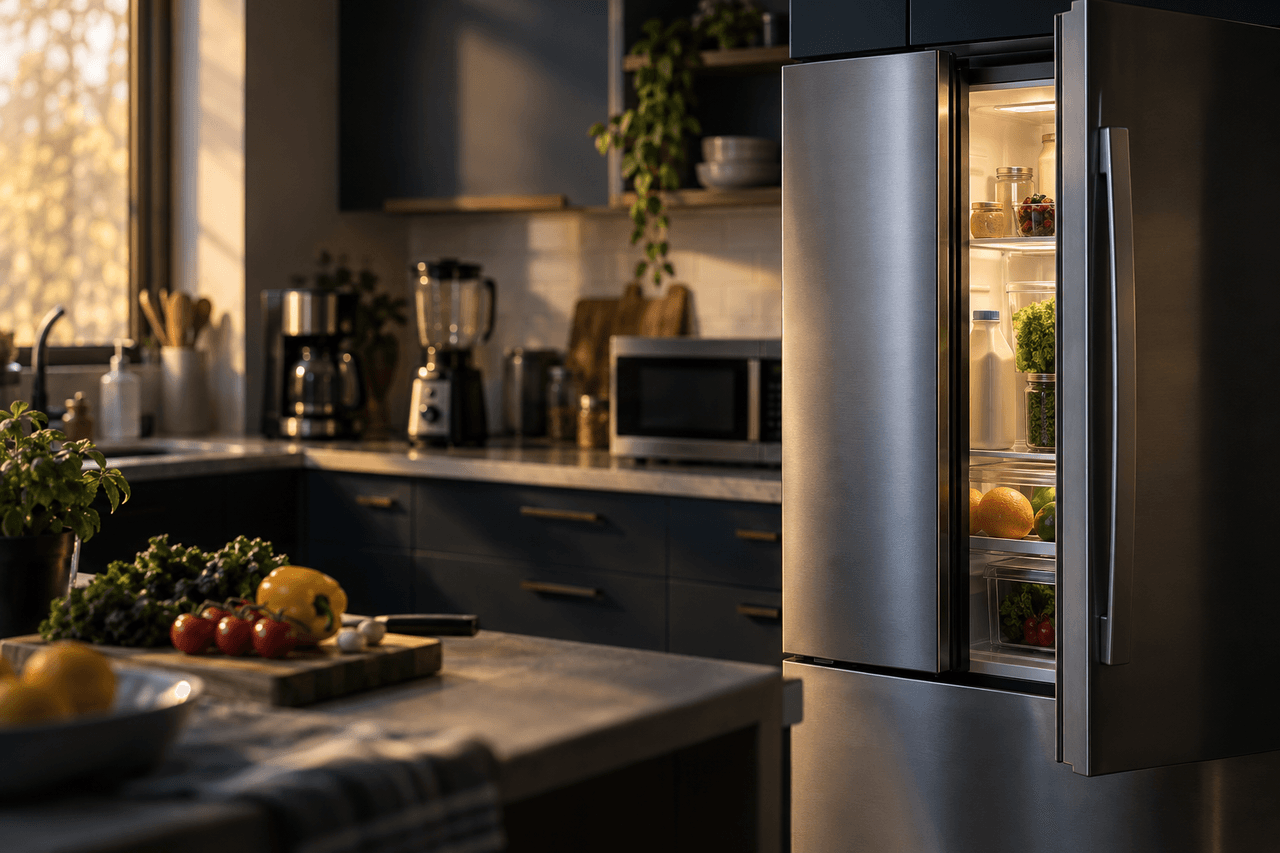
The refrigerator is the only kitchen appliance that runs continuously, which makes it the kitchen's largest single electricity consumer for most households. A typical full-size refrigerator draws between 100 and 400 watts while the compressor is running, but the compressor cycles on and off. Effective consumption for a modern Energy Star-certified 20-cubic-foot model averages roughly 400 to 500 kWh per year, per ENERGY STAR certified-product data.
At the statewide average rate of 15.88 cents per kWh, that works out to $64 to $79 per year. An older refrigerator from the early 2000s can consume twice that, making refrigerator replacement one of the few appliance upgrades with a genuine financial payback period.
Key variables that move the number up or down: ambient room temperature, how often the door opens, whether the coils are clean, and freezer temperature settings.
---
Dishwasher: Heating Water Is the Real Cost
A dishwasher typically draws 1,200 to 1,500 watts, but the heating element, which maintains water temperature and powers the drying cycle, is where most energy goes. A standard cycle on a mid-range dishwasher uses approximately 1.0 to 1.5 kWh per run.
At 15.88 cents per kWh, one load costs about 16 to 24 cents. Running the dishwasher once a day adds up to roughly $58 to $87 per year. Skipping the heated dry setting and letting dishes air-dry can cut that figure by 15 to 50 percent, depending on the model.
Hand-washing dishes uses less electricity but typically uses more hot water. Whether it saves money overall depends on how your water heater is fueled and how efficiently you wash.
---
Microwave: High Wattage, Short Duration
Microwaves are counterintuitive. They carry a high nameplate wattage, commonly 900 to 1,250 watts for countertop models, but they run for minutes at a time rather than hours. A household that reheats food for a total of 20 minutes per day uses roughly 0.3 to 0.4 kWh. Over a full year that is about 110 to 150 kWh, or $17 to $24 at the statewide average rate.
The microwave is almost never a meaningful target for energy reduction. Its convenience-to-cost ratio is hard to beat.
---
Electric Oven and Stovetop: The High-Draw Appliances
Electric ovens typically operate between 2,000 and 5,000 watts, depending on whether one element or multiple elements are active and whether the oven is preheating or maintaining temperature. A one-hour baking session in a standard electric oven uses roughly 2.0 kWh, which costs about 32 cents at the statewide average rate.
Electric stovetop burners range from 1,200 watts for a small burner to 3,000 watts or more for a large burner at full power. Burners cycle off once a pan reaches temperature, though, so an hour of active cooking rarely means an hour at nameplate draw. A household cooking two meals a day for a combined hour of burner time more realistically uses somewhere around 0.8 to 1.5 kWh per day, or $46 to $87 per year. For a reality check: EIA's 2020 Residential Energy Consumption Survey puts average annual electricity use for cooking, which it reports separately from microwaves, at 0.99 million Btu per household using that end use, or roughly 290 kWh, about $46 a year at the statewide average rate. That figure covers the oven as well as the burners, and households that cook most meals from scratch land well above it.
Induction cooktops draw comparable wattage to traditional electric coil burners but transfer heat more efficiently, so actual cooking times are shorter and total kWh consumed tends to be lower.
---
How Many Watts Does a Blender Use?
Blenders are a common search question because their motors sound powerful and the wattage ratings on the box vary widely. A standard countertop blender draws between 300 and 600 watts. High-performance blenders marketed for smoothies and soups, brands such as Vitamix and Blendtec, can draw 1,200 to 1,500 watts.
But blenders run for seconds or minutes, not hours. A 600-watt blender running for two minutes per day uses 0.02 kWh. At any reasonable Texas electricity rate, that is well under one cent per day, or roughly $1 per year at the statewide average rate. Even the most powerful residential blender is negligible in annual cost terms.
The blender question matters less for budget planning and more for understanding how to read wattage labels: peak draw and average consumption are different things, and short duty cycles change the math entirely.
---
Coffee Maker: Small Device, Surprising Draw
A drip coffee maker typically draws 600 to 1,200 watts while brewing, but brewing takes only 5 to 10 minutes. The annual electricity use for one pot per day runs about 20 to 40 kWh, or $3 to $6 per year.
The hidden cost is the warming plate. Older models keep the warming plate active for hours after brewing, adding another 60 to 100 watts continuously. Leaving a warming plate on for two hours per day adds roughly 45 to 75 kWh per year. That is a small number in isolation but larger than the brewing cost itself.
Single-serve pod machines brew quickly and skip the warming plate, but they often draw 1,400 watts or more for a short burst. On an annual basis the costs are comparable to a drip machine used at similar frequency.
---
Small Appliances: Toasters, Air Fryers, and Instant Pots
Toasters run at 800 to 1,500 watts for two to four minutes. Annual cost for daily use runs roughly $2 to $6 at the statewide average rate.
Air fryers draw 1,200 to 1,800 watts and typically run 15 to 25 minutes per meal. A household using an air fryer once a day for 20 minutes at 1,500 watts uses about 0.5 kWh per day, or roughly $29 per year at the statewide average rate. That is less than a full-size oven for comparable cooking tasks.
Electric pressure cookers and multicookers (commonly sold under brand names like Instant Pot) draw 700 to 1,200 watts but spend most of a cooking cycle at low power maintaining pressure. A typical 45-minute cooking session uses roughly 0.3 to 0.5 kWh, making these appliances among the more energy-efficient options for long-cook meals.
---
Putting It Together: Total Kitchen Electricity Cost
A household with a mid-range refrigerator, a dishwasher run once daily, an electric oven used four nights a week, a stovetop used daily, and normal small appliance usage will typically land in the range of 1,200 to 2,000 kWh per year just for the kitchen. At the Texas residential average of 15.88 cents per kWh (EIA Electric Power Monthly, July 2026 data), that translates to roughly $191 to $318 per year.
The refrigerator and cooking appliances do most of the work. The blender, coffee maker, and toaster barely register. That ordering should guide any effort to cut consumption: start with what runs longest or heats most, not what draws the highest peak wattage for the shortest time.
Use the linked deep-dives below each section to run the numbers for your specific models and usage patterns.