


In Texas, your electricity provider must follow a specific legal process before cutting off your power, and that process gives you more time and options than most customers realize.
The Public Utility Commission of Texas (PUCT) sets the rules that govern residential disconnection. Retail electric providers (REPs) operating in the deregulated market, and transmission and distribution utilities (TDUs) such as Oncor and CenterPoint, are both bound by these rules. Violating them can result in regulatory penalties. Knowing what the rules say puts you in a stronger position if your account falls behind.
How Many Days Before Electricity Shutoff in Texas?
Before a provider can disconnect your service for nonpayment, Texas law requires a written disconnection notice delivered at least 10 days before the proposed shutoff date. The notice must include the date on or after which service will be disconnected, the amount owed, and instructions on how to avoid disconnection, including any available payment arrangements.
Here is what one looks like. This is a real notice sent to a Texas household in 2026. The customer's name, address and account number are blacked out, and so is the retailer's identity. Every retailer must send this letter, so which one sent it tells you nothing useful.
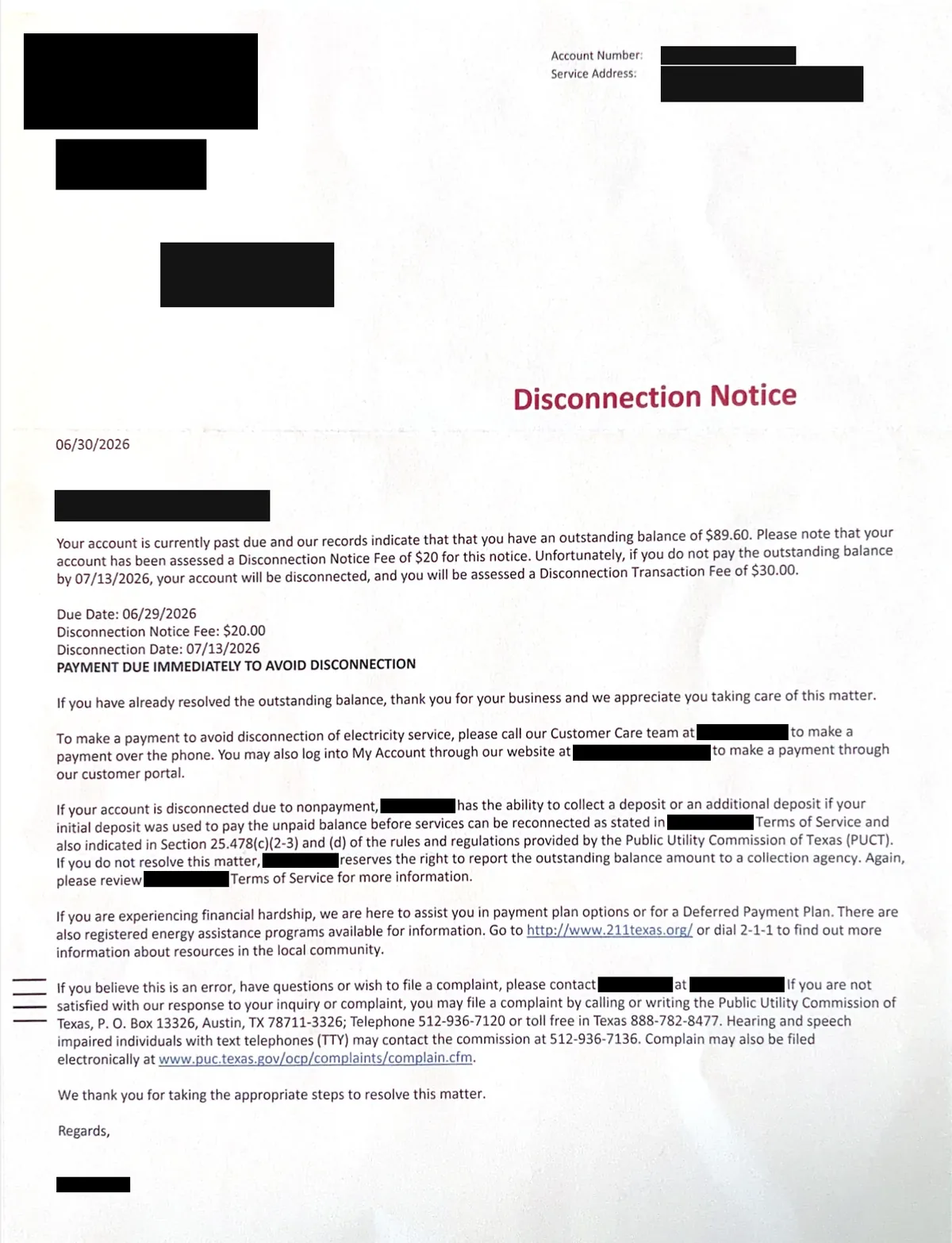
Six things on that page decide what happens next, and the two that matter most are dates:
| On the notice | What it means | What to do |
|---|---|---|
| Disconnection date (07/13/2026 here) | The earliest day your power can be cut. It has to be at least 10 days after the notice reaches you. | Count the days yourself. Fewer than 10 breaks the rule, and that is worth raising before the date, not after. |
| Due date (06/29/2026 here) | When the balance was owed. It is not your deadline to act. | Ignore the panic it creates. The disconnection date is the one that ends your service. |
| Amount owed ($89.60 here) | The past-due balance alone, not your next bill. | Pay this figure to stop the shutoff. Paying the full account balance is not required. |
| Disconnection notice fee ($20 here) | A charge for sending the letter, added before anything was cut off. | Check your Terms of Service. A fee that is not disclosed there is worth disputing. |
| Disconnection transaction fee ($30 here) | Charged only if the disconnection happens. | Paying or arranging a plan before the date avoids it completely. |
| The PUCT paragraph | Your right to escalate past the retailer, printed because the rules require it. | If the retailer will not resolve it, call the PUCT at 888-782-8477. |
Notice what is missing from that letter: any mention of the banned days below, or of the weather rules that can override the disconnection date entirely. The notice tells you the earliest date service can be cut. It does not promise the retailer is allowed to cut it that day.
That 10-day window is a floor, not a ceiling. Some providers build in additional grace periods, but they are not required to do so beyond the statutory minimum. The notice is typically mailed or, if you have consented to electronic communications, sent by email. Check your account settings to confirm how your provider sends critical notices, because missing a disconnection warning due to a spam filter does not pause the 10-day clock.
If you pay the overdue amount, or make an acceptable payment arrangement, before the stated disconnection date, the provider must cancel the scheduled shutoff. Once service is disconnected, a reconnection fee applies. Those fees vary by TDU: Oncor charges $10.78 for remote reconnection and $22.44 for a field visit, as of its current tariff on file with the PUCT. AEP Texas and CenterPoint publish their own fee schedules in PUCT filings.
Days When Disconnection Is Prohibited
Even if proper notice has been given and the balance remains unpaid, Texas law prohibits disconnection on certain days. Providers cannot cut off residential service:
- On a Friday, Saturday, or Sunday
- On a state or federal holiday
- On the day before a state or federal holiday
- After 4:00 p.m. on any day that the provider's customer service office will not be open the following business day
The practical effect is that disconnections are largely limited to Monday through Thursday, and only during normal business hours. This rule exists so that customers who are disconnected always have immediate access to a working customer service line to resolve the issue or arrange reconnection.
If a provider disconnects service on a prohibited day, that is a violation of PUCT Substantive Rule 25.483. Customers can file a complaint directly with the PUCT at puc.texas.gov or by calling 1-888-782-8477.
The Extreme Weather Disconnection Ban
Texas has a seasonal disconnection moratorium that protects customers during periods of dangerous heat and cold. Under PUCT rules, providers cannot disconnect residential service for nonpayment:
- When the National Weather Service has issued a heat advisory, excessive heat warning, or heat watch for the customer's area
- When the forecast low temperature for the following night is at or below 32 degrees Fahrenheit
The extreme weather disconnection ban applies to all residential customers, not just those on medical or income-based assistance programs. A provider that shuts off power during a qualifying weather event is in violation of state rules regardless of how long the account has been past due.
It is worth noting what this moratorium does not do. It does not forgive the underlying balance. Interest or late fees may continue to accrue depending on your contract terms. Once the qualifying weather condition ends, the provider can proceed with disconnection under normal rules, including issuing a new or continuing notice. Customers who fall behind during a moratorium period should use that time to contact their provider about a payment plan rather than assume the debt has been paused indefinitely.
After Winter Storm Uri in February 2021, the PUCT and the Texas Legislature strengthened several consumer protections related to extreme weather. Senate Bill 3 (87th Legislature) and subsequent PUCT rulemaking reinforced the obligation of utilities to protect customers during declared weather emergencies. The PUCT's current rules on this subject are codified in Substantive Rule 25.483.
Medical Baseline and Critical Care Protections
Customers with a household member who depends on electricity for a life-sustaining medical condition can apply for critical care or chronic condition designation. Under PUCT rules, a provider cannot disconnect a critical care residential customer at any time, even for nonpayment, without first completing additional notification steps that include contact attempts by phone.
To qualify, a licensed physician must certify that loss of electricity would create a serious risk to the health or safety of a member of the household. The application form is submitted to the TDU, not to the REP. Designation lasts for 12 months and must be renewed annually.
Critical care designation is not a payment exemption. Balances still accumulate, and the provider can pursue collection. However, the physical act of cutting power is held to a significantly higher standard of process. Customers who believe they qualify and have not applied should contact their TDU directly. Oncor's critical care application is available at oncor.com; CenterPoint's is at centerpointenergy.com.
When Switching Providers Does Not Help
Some customers assume that switching to a new REP will reset a past-due balance or prevent a pending disconnection. It will not. The TDU, which physically controls the meter, enforces disconnection orders regardless of which REP holds the account. A switch in progress does not pause or cancel a disconnection that has already been authorized.
Furthermore, most REPs conduct a credit check or review payment history before accepting a new customer. A recent disconnection or significant past-due balance can result in a deposit requirement, sometimes equal to one-sixth of your estimated annual bill under PUCT rules, or outright denial. Households quoted a deposit they cannot pay after a disconnection still have paths back to service; this guide to no-deposit electricity for low-income Texans walks through the options that require no cash upfront.
If disconnection is imminent, the most effective step is to contact the current provider directly and ask about deferred payment arrangements. PUCT rules require REPs to offer residential customers the option of a payment arrangement before disconnecting service for the first time in a 12-month period. The arrangement must allow the customer to pay the overdue amount over a period of at least six weeks. That requirement is in Substantive Rule 25.480.
What to Do If Your Power Is Cut Off Illegally
If a provider disconnects service in violation of any of the rules described above, including disconnecting on a prohibited day, during a weather event, or without the required 10-day notice, the customer has a right to file a formal complaint with the PUCT. The PUCT's Office of Customer Protection investigates complaints and can order reconnection and assess fines against providers.
Document the disconnection date and time, save any notices you received, and note the weather conditions if an extreme weather ban may apply. That documentation supports a complaint and, in some cases, a request for billing credits.
The PUCT complaint line is 1-888-782-8477. Complaints can also be filed online at puc.texas.gov. For customers who cannot resolve a dispute directly with their provider, the PUCT's informal complaint process is free and typically produces a response from the provider within 21 days.
The Bottom Line
Texas law gives residential electricity customers meaningful protections before, during, and after a potential disconnection. The 10-day notice requirement, the prohibited-day rules, the extreme weather moratorium, and the critical care provisions all create windows of time and opportunity to resolve a billing problem before the lights go out. Customers who understand these rules are far better positioned to use them.